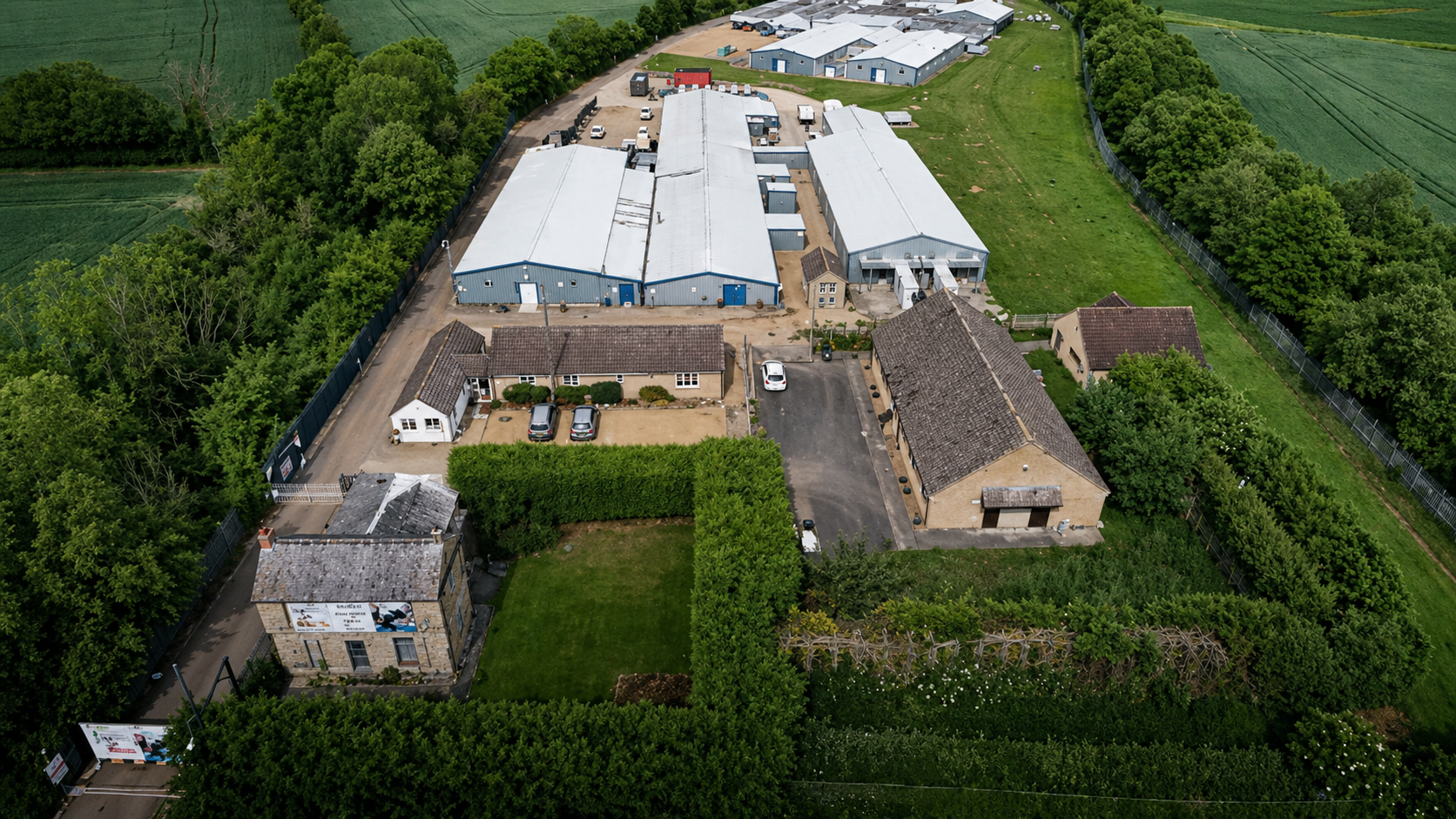
“Why don’t you just go in and take them?”
It’s the question we get asked more than any other — and if you’ve asked it, you already understand what’s at stake. Here is the honest, uncomfortable answer, from people who want those doors open as much as you do: a large-scale open rescue is not what’s best for the dogs. This page explains why — and what actually works instead.
We feel it too
The urge is right. We honour it.
In 2022, twenty-three beagles were carried out of MBR Acres in daylight by people who couldn’t stand by any longer. Two juries — at Cambridge and Peterborough Crown Courts — looked at open rescues from this facility and acquitted the defendants. Ordinary British jurors, twice, declined to call it dishonest. Those dogs are asleep on sofas today.
Nothing on this page is a judgment of the people who did that. They are part of why the country knows this facility exists.
But 2026 is not 2022. The law has been rewritten, the policing has been industrialised, and scale changes everything. What worked once as an act of conscience by a dozen people cannot work as a strategy for two thousand dogs — and pretending otherwise would cost the dogs more than it saves.
The law, deep-dived
Parliament reclassified a puppy factory as national infrastructure
Section 7 of the Public Order Act 2023 created an offence of “interfering” with key national infrastructure — the legal category built for power stations, airports, railways and hospitals.
On 14 January 2026 the House of Lords approved a Statutory Instrument adding “life sciences infrastructure” to that list. From 11 February 2026, MBR Acres — a commercial dog-breeding business — sits in the same protected legal category as the national grid.
What that means in practice
- Up to 12 months in prison and an unlimited fine for “interference” — a word the Act defines so broadly it can reach a blocked gate or a slow march, let alone entry to the site.
- The burden of proof is reversed. Under s7(4) it is for youto prove you had a reasonable excuse — not for the Crown to prove you didn’t.
- It is already being used. The first arrests at MBR Acres came on 24 February 2026 — thirteen days after the law took effect.
The local MP told the House of Commons he could not see that the regulations had been introduced for any reason “other than to address the presence and actions of Camp Beagle”. A judicial review — filed 2 March 2026, arguing the regulations breach the rights to free expression and peaceful assembly — is working through the High Court, and we back it. But today, the law stands. It was built precisely to make what you’re asking about a fast route to prison.
The policing reality
Stopped before it starts
Cambridgeshire Police have spent more than £2.1 million policing MBR Acres since 2021. That buys a standing operation: cameras, injunction zones, intelligence-led monitoring and rapid response. Large-scale direct action in the UK isn’t defeated at the fence — it is intercepted at the planning stage, on the road, before anyone arrives. That is what the money is for.
And here is the uncomfortable, human truth: most police officers have no appetite for spending their shifts guarding a beagle factory — some will quietly tell you exactly that. But an instruction to attend is not optional. An officer who refuses duty loses their career. Private sympathy inside the force does not create space for a rescue; the institution will always show up, whatever the individual officers in the van think of the job they’ve been handed.
Look at Wisconsin. Over a thousand people converged on Ridglan Farms on 18 April 2026 — and not one dog left the site that day. Tear gas, rubber bullets, twenty-five arrests. In the UK, with pre-emptive powers the Wisconsin police could only dream of, a mobilisation that size would be stopped en route. The state has decided this facility does not fall — and it has written itself the tools to enforce that.
The part nobody wants to hear
Empty the sheds, and the business doesn’t even blink
Suppose it somehow worked. Suppose every dog came out in one night. To MBR Acres, those dogs are stock — inventory, with an insured value like any other business asset.
Empty sheds become an insurance claim. An insurance claim becomes restocked sheds. Within months the facility is breeding again — same licence, same buildings, same customers. A raid saves this year’s dogs by guaranteeing next year’s. The one thing it cannot touch is the thing that matters: the licence to breed.
It gets worse. Dogs recovered by police get returned. In December 2022, two rescued puppies — Love and Libby — were intercepted and handed back to MBR Acres, where facility protocol means they were almost certainly killed as “contaminated”. For the exact dogs it reaches, a failed rescue can be a death sentence.
And strategically, a mass raid hands the industry a victim story, hands the government the justification to finish criminalising everything this movement does lawfully, and spends the campaign’s people — the drivers, the organisers, the witnesses — on prison sentences instead of on the fight that ends this.
The win condition
Facilities don’t close when their sheds are emptied. They close when the state stops protecting them.
Green Hill — Marshall’s Italian beagle factory — was emptied by the authorities: dogs seized by court order, executives convicted, the facility never reopened. No insurance claim can rebuild that.
Ridglan Farms — the closest US equivalent to MBR Acres — closed for good in 2026 and released more than two thousand beagles. Not because its sheds were raided: because prosecutors, courts, licence surrender and federal pressure made it impossible to continue. The movement made Ridglan impossible to ignore; the state closed it. And when a facility closes that way, every dog comes out lawfully — with vets, into rescue, permanently.
That is the win condition here: make it legally, politically and commercially impossible to breed dogs at Wyton. The establishment licence can be revoked under the Animals (Scientific Procedures) Act. Sixty-five companies have already walked away from MBR. Parliament has debated it twice and MPs of every party are on record. The fastest route to those dogs isn’t over the fence — it’s through the licence.
So this is the route
Channel the urge. Win in a way that sticks.
If you feel the pull to do something drastic for these dogs, that instinct is precious — don’t waste it on a route that restocks the sheds. Spend it where it compounds:
Write to your MP
Most MPs already agree. Put your name on the record asking yours to act — two minutes, no account needed.
Demand ASRU transparency
Push the regulator’s audits, licences and numbers into the light. Sunlight is what licences don’t survive.
Back the parliamentary route
EDMs, written questions, debates — keep Wyton on the order paper until the licence question can’t be dodged.
Raise awareness where you live
Street stalls, local events, conversations. Most people still don’t know. Awareness moves every other lever.
Nobody is coming to save these dogs except us. That is exactly why we have to win in a way that sticks — every dog out, lawfully, permanently, and no dogs bred to replace them.